Military Despotism
Federalist PapersMilitary Despotism names the political danger that military preparations, adopted in the name of safety, can become instruments of domination. In the Federalist essays, disunion sets that danger in motion: exposed borders and mutual suspicion make war recurrent, war encourages standing armies and enlarges executive authority, and prolonged military necessity lowers the citizen’s standing until people find it difficult to resist military-backed usurpation. The argument makes security a constitutional question, not merely a military one, and presents preservation of the Union as a way to avoid the conditions that would make despotism appear necessary.
The Cycle of Insecurity and Militarization
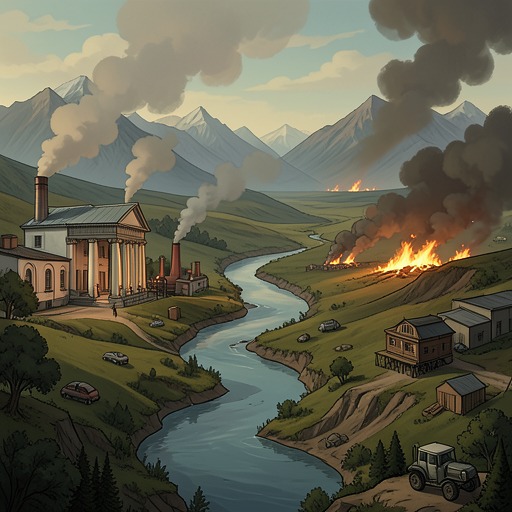
The argument begins with a contrast between Europe’s defended frontiers and the vulnerability that would characterize a disunited America. In a country without sufficient fortifications, the borders between states would be open to incursions, and more populous states could overrun less populous neighbors. Such victories would be difficult to retain, so conflict would tend toward repeated raids and devastation rather than decisive conquest. The result would be not simply danger to the state, but a military environment in which the losses and suffering of individuals became central.
The essays treat this pattern as a political mechanism with a predictable next stage. Persistent external danger would require continual preparation; the weaker states or confederacies, unable to match their neighbors in population and resources, would be the first to adopt disciplined troops, fortifications, and more regular defense. Once those measures gave their users a military advantage, stronger neighbors would not long accept the resulting loss of security or status. They, too, would imitate the same preparations. Rivalry would thus spread the military institutions initially adopted by the vulnerable, until every part of the country possessed what the argument calls the engines of despotism.
This forecast is not presented as a speculative objection to a particular constitutional clause. The essays acknowledge that the proposed Constitution does not expressly provide against standing armies, while emphasizing that their existence under it is uncertain. Their more substantial claim is that standing armies would be an almost inevitable consequence of dissolving the Confederacy: frequent war and constant apprehension would make them seem indispensable. The feared outcome therefore follows, in this account, not simply from the presence of military power but from the political conditions that make a permanent military establishment seem necessary.
How Military Power Displaces Civil Authority
The danger extends beyond the size of an army. States compelled to defend themselves would also strengthen their executives, because war tends to increase executive authority at the expense of legislative power. Military preparation consequently changes the balance within government as well as the relation between government and the public. What begins as a response to danger can direct a constitution progressively toward monarchy.
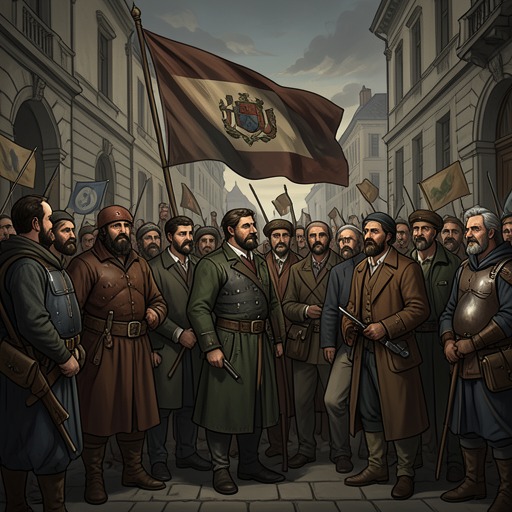
In a country repeatedly exposed to war, an army must be numerous enough for immediate defense, and soldiers acquire greater importance through the continual demand for their service. At the same time, the citizen’s condition is diminished. People living in territories that repeatedly become theatres of war suffer infringements of their rights; those infringements gradually weaken their sense of the rights themselves. The shift is consequential: inhabitants come to regard soldiers first as protectors, then as superiors, and eventually as masters. Once that disposition takes hold, resistance to usurpations backed by military force becomes difficult to summon effectively.
The argument therefore distinguishes between an army operating within a comparatively secure political setting and one embedded in permanent insecurity. Under the former conditions, soldiers might help a magistrate suppress a small faction, an occasional mob, or an insurrection, yet remain unable to impose encroachments against the united efforts of the population. Under the latter, continual military necessity elevates the military state over the civil one. The difference lies not only in military strength, but in the public habits and expectations formed around its use.
Britain and the Security of Union
Great Britain supplies the contrasting case. Its island position and powerful navy, the essays argue, reduce the likelihood of foreign invasion and therefore remove the need for a large domestic army. A force capable of resisting a sudden descent until the militia could assemble was considered sufficient; public opinion would not have tolerated a larger establishment. Because Britain had little need for the military preparations associated with internal war, its circumstances helped preserve liberty despite the corruption the essays attribute to its politics.
The comparison is expressly conditional rather than absolute. Had Britain been situated on the European continent and compelled to maintain military establishments comparable to those of the other major European powers, the argument says, it would probably have fallen under the absolute power of one man. Its liberty might be lost through other causes, but not, in this account, through the prowess of the relatively small domestic army it usually maintained. Geography matters because it moderates the demand for military power; it is not offered as a guarantee that liberty cannot be endangered in other ways.
The Union, in turn, could give the United States an advantage resembling Britain’s relative insulation. Europe lay at a great distance, and European colonies nearby were expected to remain too weak to pose a serious threat. If the Union endured, extensive military establishments would therefore not be necessary for security. If it dissolved—whether into separate states or, more probably, into two or three confederacies—the country would instead face the rivalry and insecurity of continental powers. The central consequence would be a grim reversal: institutions adopted to defend liberty from neighboring ambition would expose liberty to the means of defending against that ambition.
Constitutional Judgment and the Union’s Purpose
This account of military despotism belongs to a larger argument that political arrangements should be assessed by their practical operation and consequences. The Federalist essays portray the existing Confederation as unable to carry out important measures when execution depends on the separate administrations of its members. Each state can examine collective measures through the lens of local interests and immediate convenience; thirteen distinct sovereign wills are required for the complete execution of every important Union measure. Unequal compliance then encourages other states to withhold support, until the national government’s operations are nearly arrested. Such weakness is not depicted as a stable alternative to concentrated power: it risks producing the insecurity that makes concentrated military power attractive.
The proposed Constitution is accordingly defended as neither wholly national nor wholly federal, but a composition of both. Its foundation is federal because adoption depends on the assent of the people acting through their distinct states, rather than a majority of the whole population. Its ordinary powers draw on both national and federal sources: the House represents people proportionally, the Senate represents states equally, and presidential selection combines state-based features. In its ordinary operation, however, government acts chiefly on individuals, giving it a national character; in the extent of its powers and the amendment process, its character is again mixed. This analysis helps distinguish a government capable of acting from one whose authority simply abolishes the states’ independent place in the political arrangement.
The proposed system is also presented as the product of a crisis and a deliberative process, not as an unquestionable final answer. The convention’s authority was advisory and recommendatory; its proposed Constitution would have no force unless approved by those to whom it was presented. Its members, the essays argue, recognized both the gravity of the crisis and the urgency of reform, while public anxiety and opposition made fair consideration difficult. The proper response, in this account, is to examine the plan carefully and judge its likely effects rather than allow predetermined condemnation or approval to settle the question.
That emphasis on experience also qualifies confidence in constitutional design. The essays note that the defects of the Articles of Confederation were not clearly identified in the objections raised during their ratification; actual trial disclosed a radical error that prior argument had missed. Errors in the new plan, too, might become apparent only through practical experience. The warning against military despotism thus reinforces a broader case for institutional judgment under uncertainty: preserve the Union not because a constitution is beyond correction, but because dissolution threatens to generate conditions in which liberty is sacrificed to security.
A Warning About Security and Liberty
The concept’s force lies in its reversal of a familiar promise. Military establishments are defended as protection, yet the escalating insecurity that calls them forth can reorder public life: the soldier’s importance rises, civil authority loses ground, and citizens become less able to oppose military power. Security is therefore not a simple good separable from constitutional liberty. When fear becomes permanent, it may lead a people to accept institutions that endanger the rights those institutions were meant to protect.
The Union is cast as a preventive structure in this chain of consequences. By reducing the likelihood of rivalry among neighboring American states and limiting the need for vast military preparations, it could protect liberty without relying on the continual expansion of force. Military Despotism is consequently both a predicted danger of disunion and a test of political design: whether a government can provide security while avoiding the cycle in which defensive power grows until it dominates the civil order.